How to write a CV · Free South African guide
How to write a CV, step by step.
Follow these steps in order and you'll have a clear, honest CV you can adapt for every application.
- Seven clear steps
- What SA employers expect
- What to leave out
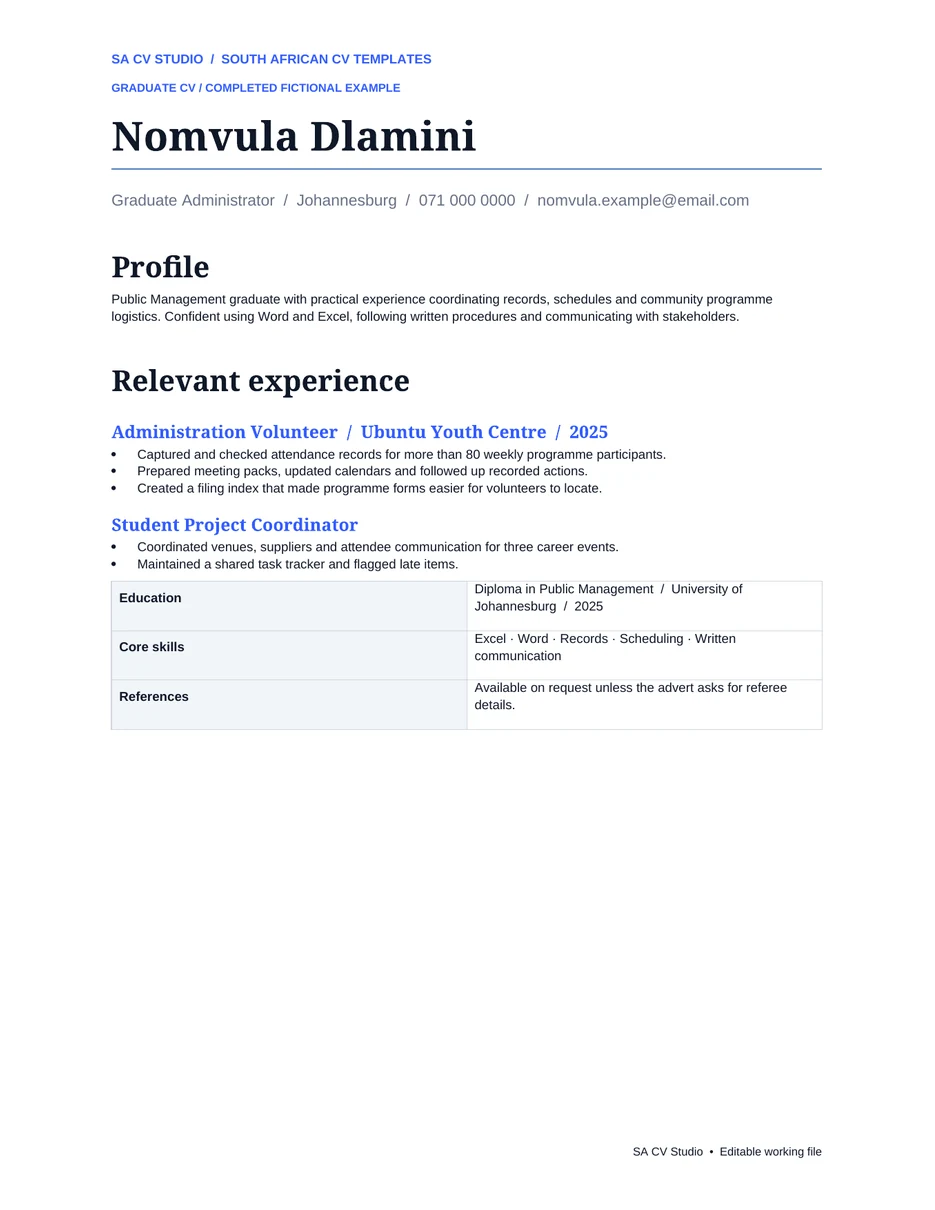
- Free template excerpt
The steps
- 1. Contact details: name, phone, email, town. A professional email address.
- 2. Profile: 2 to 3 lines about who you are and the work you want.
- 3. Work experience: most recent first, with month and year dates and 3 to 5 bullets each.
- 4. Education: highest first, including matric.
- 5. Skills: computer, languages, driver's licence code if relevant.
- 6. References: two or three, or 'available on request'.
- 7. Save as PDF and name it Firstname-Surname-CV.pdf.
Leave out
- Religion, marital status and photos unless asked.
- Your full ID number unless the employer requests it (share it on the Z83 for government).
- Salary history on the CV itself.
- Anything you can't prove.
Length
Two pages is typical. One page is fine with little experience. Public-service CVs may run longer because panels want full detail.
How to write strong work experience bullets
Employers look for active verbs and clear outcomes rather than a passive list of daily tasks. When writing about your past roles, explain how well you did the work. This helps the hiring manager see your potential value.
Consider these fictional examples for an administrative assistant:
- Managed a busy reception desk, answering up to 50 phone calls daily and routing visitors to the correct departments.
- Organised the physical and digital filing systems, which reduced document retrieval time for the team.
- Coordinated weekly meeting schedules and prepared accurate agendas for five senior managers.
What South African hiring panels look for
Before a human reads your CV, they often do a quick compliance check. In South Africa, hiring managers and selection panels look for immediate alignment with the job advert. If the advert asks for specific qualifications, a driver's licence, or professional registration (like SACE or SANC), make sure these are highly visible on your first page.
- Does your CV use the exact keywords and job titles from the advertisement?
- Are your certificates and licences listed clearly with their registration numbers?
- Do your employment dates show a clear timeline without unexplained gaps?
- Are your references reachable and aware that they may be contacted?
What to do after you apply
Applying is only the first step. To stay organised and ready for callbacks, you need a simple follow-up system. South African employers often call from private or unknown numbers, so keep your phone nearby and answer professionally during business hours.
- Record every application in a simple spreadsheet with the employer's name, job title, and closing date.
- Save a copy of the original job advertisement, as expired job posts are often taken down.
- Prepare a quiet space in your home where you can take an unexpected screening call.
- Check official portals like dpsa.gov.za or the employer's careers page regularly to track your application status.
Common questions
Do I need to certify my documents when sending my CV?
For private-sector jobs, you usually do not need to attach certified documents unless requested. For government jobs via dpsa.gov.za, recent directives state that only shortlisted candidates need to submit certified documents. Always read the specific job advert carefully to confirm their current requirements.
Should I include my matric marks on my CV?
If you are a recent school leaver or applying for entry-level positions, internships, or bursaries, including your matric subjects and symbols is helpful. For experienced professionals, simply listing your school, passing year, and that you obtained a National Senior Certificate is sufficient.
How do I explain a long gap in my employment history?
Be honest and brief. You can list the dates of the gap on your CV with a simple, professional explanation, such as 'Family caregiving duties' or 'Freelance project work'. Use your profile summary to focus on your current readiness to return to full-time employment.
Free guides for this
CV writing
How to write a CV in South Africa (with a simple format)
CV writing
A clear South African CV structure that recruiters can scan
CV writing