Bursaries · Free South African guide
How to find and apply for bursaries in South Africa.
Bursaries come from government (including NSFAS), companies, SETAs and universities. Each has its own rules and closing dates. Apply only on official websites.
- Where genuine bursaries are advertised
- Documents to prepare
- Motivation letter tips
- Tracker for closing dates
Where to look
- NSFAS for government student funding (nsfas.org.za).
- Your university or TVET college financial aid office.
- Company careers pages (mining, banking, engineering, retail).
- SETA websites for sector bursaries.
- Provincial government bursary programmes.
Documents usually requested
- Certified ID copy
- Latest results or matric certificate
- Proof of registration or acceptance
- Proof of household income where required
- Motivation letter
Scam warning
Real employers and government departments never ask you to pay for a job, an interview, training or a 'registration fee' to be shortlisted. If someone asks for money or your banking PIN, walk away and report it.
How to draft your motivation letter
A bursary committee looks for academic potential, financial need, and a clear career plan. Avoid vague statements like 'I want to study.' Instead, connect your chosen field of study to South Africa's development goals or the specific sector of the funder.
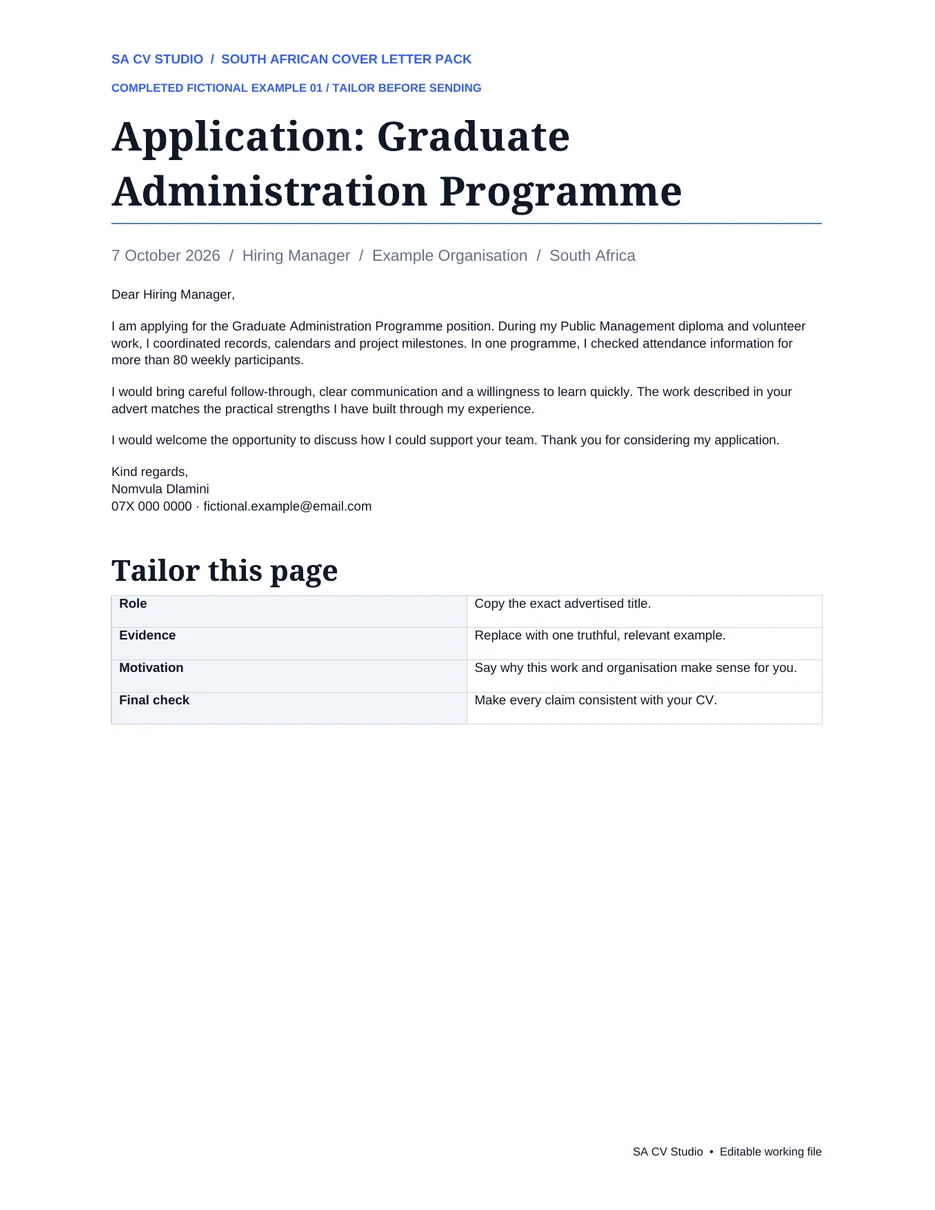
Use this fictional layout to structure your letter:
- Paragraph 1: State what you are studying and your career goals (e.g. 'I am studying towards a BSc in Chemical Engineering to work in sustainable water purification').
- Paragraph 2: Explain your financial situation honestly without sounding entitled. Mention if you are the first in your family to attend university.
- Paragraph 3: Share your leadership potential, community work, or high school achievements to prove you are worth the investment.
Getting your proof of income right
Many applications are rejected immediately because of incorrect financial documents. If your parents or guardians are employed, you must provide their latest payslips (usually not older than three months) or consecutive bank statements.
If your guardians are self-employed, unemployed, or informal workers, you must submit specific proof. Always confirm the exact, current requirements on the official provider's website before submitting. Usually, this includes:
- A signed affidavit from the South African Police Service (SAPS) stating their employment status and estimated monthly income.
- Official SASSA grant letters showing the monthly payout amounts.
- A certified death certificate if one or both of your parents are deceased.
Tracking your bursary applications
Applying for funding is a numbers game, and relying on just one application is risky. Create a simple system to keep track of your progress and stay organised throughout the academic year.
- Create an Excel sheet or a notebook with columns for the bursary name, closing date, date applied, and required follow-up.
- Check your email inbox, including the spam folder, at least twice a week for updates or requests for outstanding documents.
- Keep certified digital copies of your ID, matric certificate, and latest academic transcript in a secure cloud folder for quick access.
- Never pay any application fees, as legitimate bursaries never charge you to apply or be shortlisted.
Common questions
Can I apply for NSFAS and a private bursary at the same time?
Yes, you can apply for both to secure your options. However, if you are approved for both, you must inform both parties. Most private bursaries and NSFAS do not allow double funding, and you will have to choose one.
What does it mean when a bursary is service-binding?
A service-binding bursary means the funder requires you to work for them after you graduate. Usually, you must work for the company for the same number of years they paid for your studies. Always read the contract carefully before signing.
Do I have to pay back a bursary if I fail a module?
This depends on the specific contract. Some providers allow you to repeat a module at your own cost, while others may suspend your funding or convert the bursary into a student loan. Check the official rules on the provider's website.
Free guides for this
Job hunting
How to apply for learnerships and internships in South Africa
Job hunting
How to spot job scams before you share documents or pay
Job hunting