Motivation letter · Free South African guide
How to write a motivation letter that gets read.
A motivation letter explains why you want this opportunity and why you are a good fit. Keep it to one page, specific and honest.
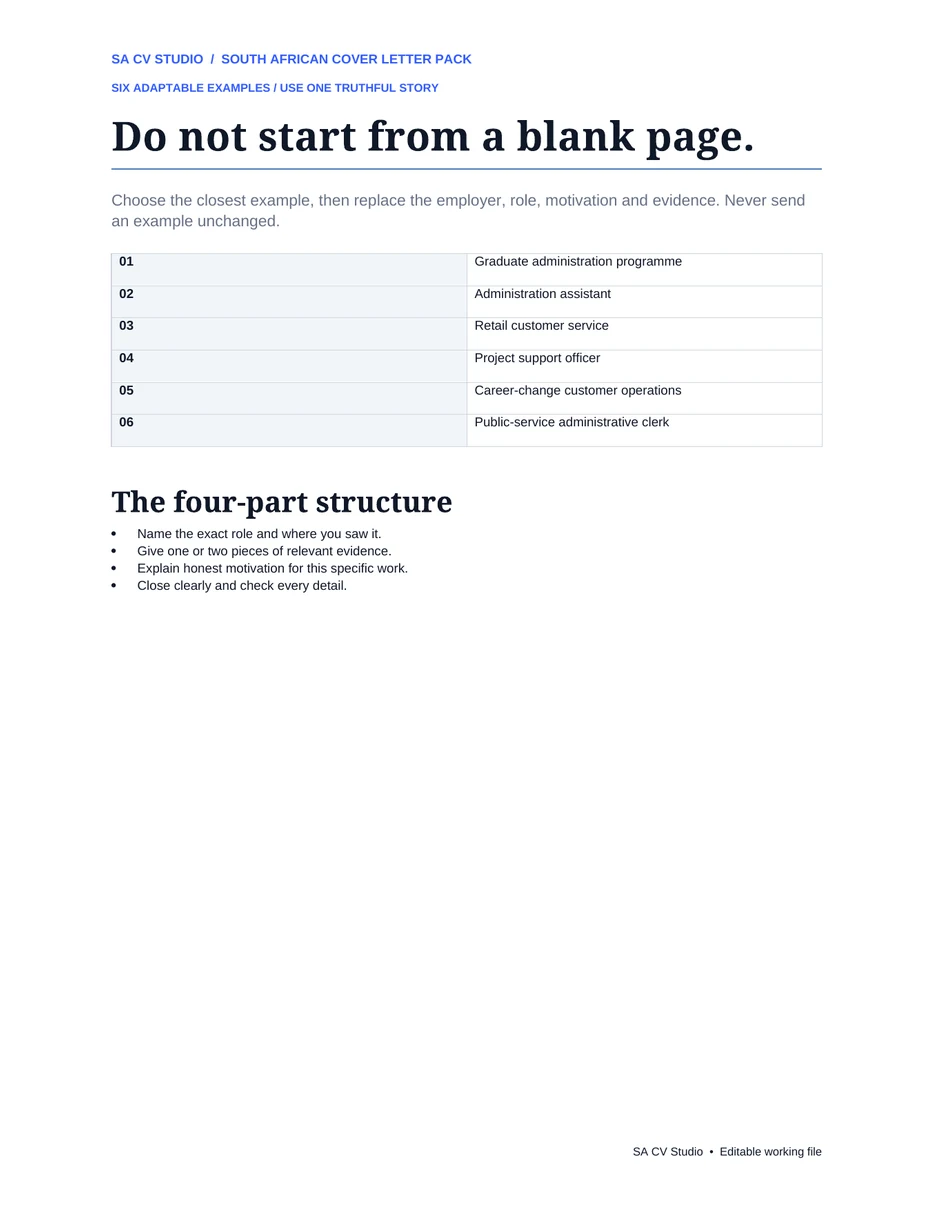
- Simple 4-paragraph structure
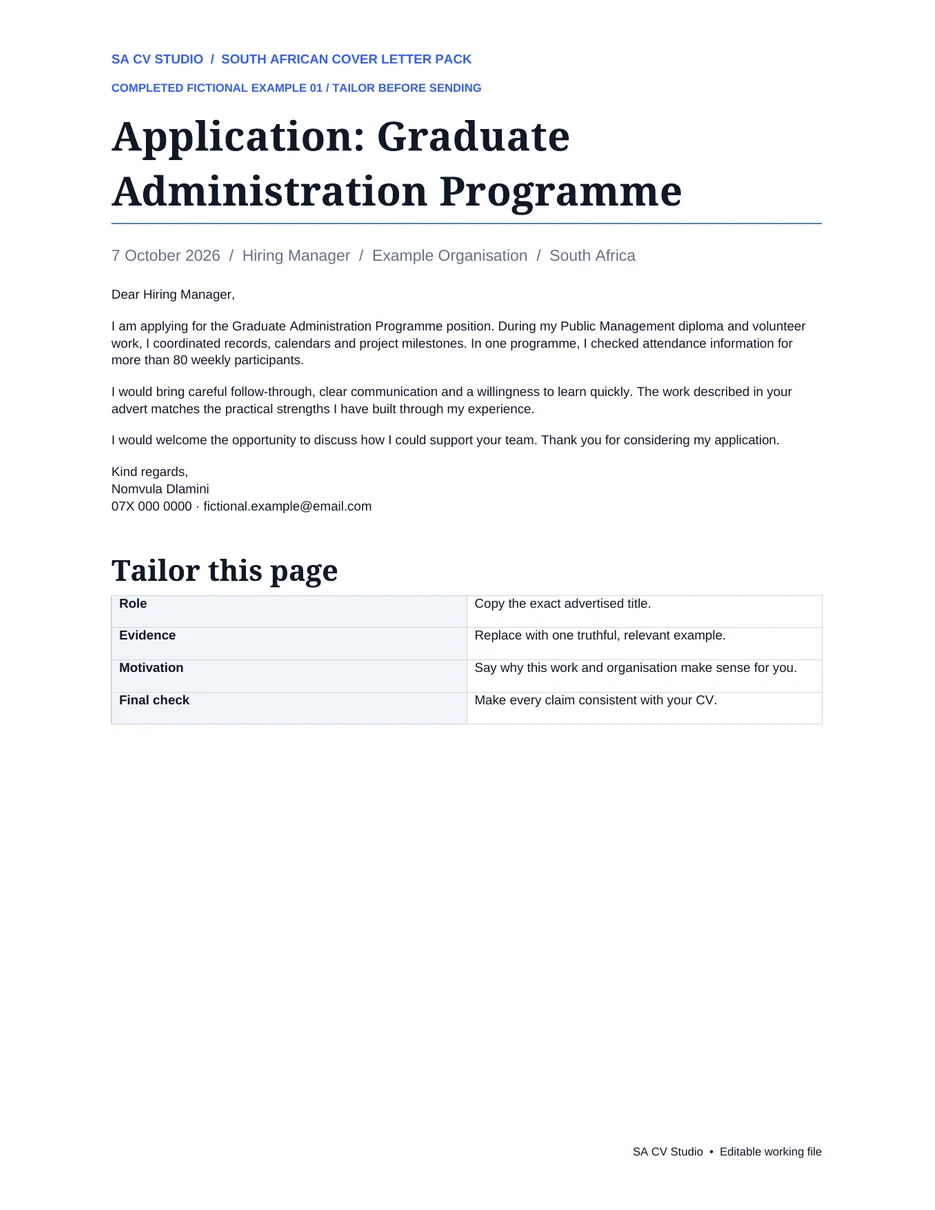
- Example wording you can adapt
- Free letter builder
- Matching cover letters in the toolkit
Structure
- Opening: what you're applying for and where you saw it.
- Why you: your studies, skills or experience that match the requirements.
- Why them: what you know about the organisation or programme and what you want to learn.
- Close: availability, thanks and contact details.
Example opening
"I am applying for the 2026 Retail Learnership advertised on your website. I completed matric in 2025 with Mathematical Literacy and Business Studies, and I have weekend experience helping customers at a family spaza shop."
Use the free builder
Our free letter builder lays out a motivation letter for you to print or save. Find it under Free tools.
What selection panels look for in South Africa
South African selection panels, whether for a university bursary, a national government department via dpsa.gov.za, or an entry-level learnership, read hundreds of applications. They do not look for complex English or copied templates. Instead, they search for specific, practical indicators that you meet their exact criteria.
For a bursary, panels look for your academic potential and clear proof of financial need. For a learnership or internship, they look for basic readiness to learn, reliability, and local community connection.
- Absolute alignment: Mentioning the exact reference number and title from the official advert.
- Local context: Describing how the opportunity fits your long-term career goals in South Africa.
- Real-life examples: Mentioning school leadership, community volunteering, or informal work like helping in a local shop.
Writing the 'Why Me' section with examples
The middle of your letter must connect your background to the opportunity. If you do not have formal work experience, focus on your school subjects, community projects, or informal roles. Avoid making vague statements about being a hard worker. Instead, use factual examples.
Here are two fictional examples you can adapt to your own situation:
- Fictional learnership example: 'During school, I managed the sports equipment inventory for our local soccer team. This taught me how to keep accurate records and work under pressure, which matches the admin skills required for this role.'
- Fictional bursary example: 'I achieved a level 6 in Mathematics in my final matric exams. I want to study Civil Engineering because our local municipality needs qualified water infrastructure planners.'
Common mistakes and how to submit
Before you send your motivation letter, complete a final checklist to avoid simple mistakes that lead to automatic rejection. Check that you have spelled the contact person's name and the company name correctly. If no contact person is listed, address your letter to 'The Selection Panel' or 'The Hiring Manager.'
Save your letter as a PDF unless the application system asks for a Word document. Large files can fail to upload on platforms like sayouth.mobi, so keep your file size under two megabytes. Always double-check the official application portal or the employer's careers page to confirm current submission guidelines.
Common questions
How long should a motivation letter be?
One page, about 250 to 400 words, unless the application asks for something different.
Should I physically sign my motivation letter?
Yes, if you are uploading it as a PDF or mailing a printed copy. You can sign it electronically or print, sign, and scan it. If you are copying and pasting the text into an online application portal, a typed signature at the bottom is sufficient.
Can I use the same motivation letter for every application?
No. Standard letters are easy to spot and often ignored. Always adapt the middle paragraphs to match the specific job requirements or bursary criteria listed in the advert. Confirm the latest submission details on the official employer website before applying.
What is the difference between a cover letter and a motivation letter?
In South Africa, the terms are often used interchangeably. However, a cover letter usually focuses closely on professional work experience for a job, while a motivation letter focuses on your drive, personal story, and potential for bursaries, internships, or learnerships.
Free guides for this
CV writing
How to write a cover letter for a South African job
Job hunting
How to apply for learnerships and internships in South Africa
CV writing